Material Spotlight: Agatized Coral and Its Use in Jewelry
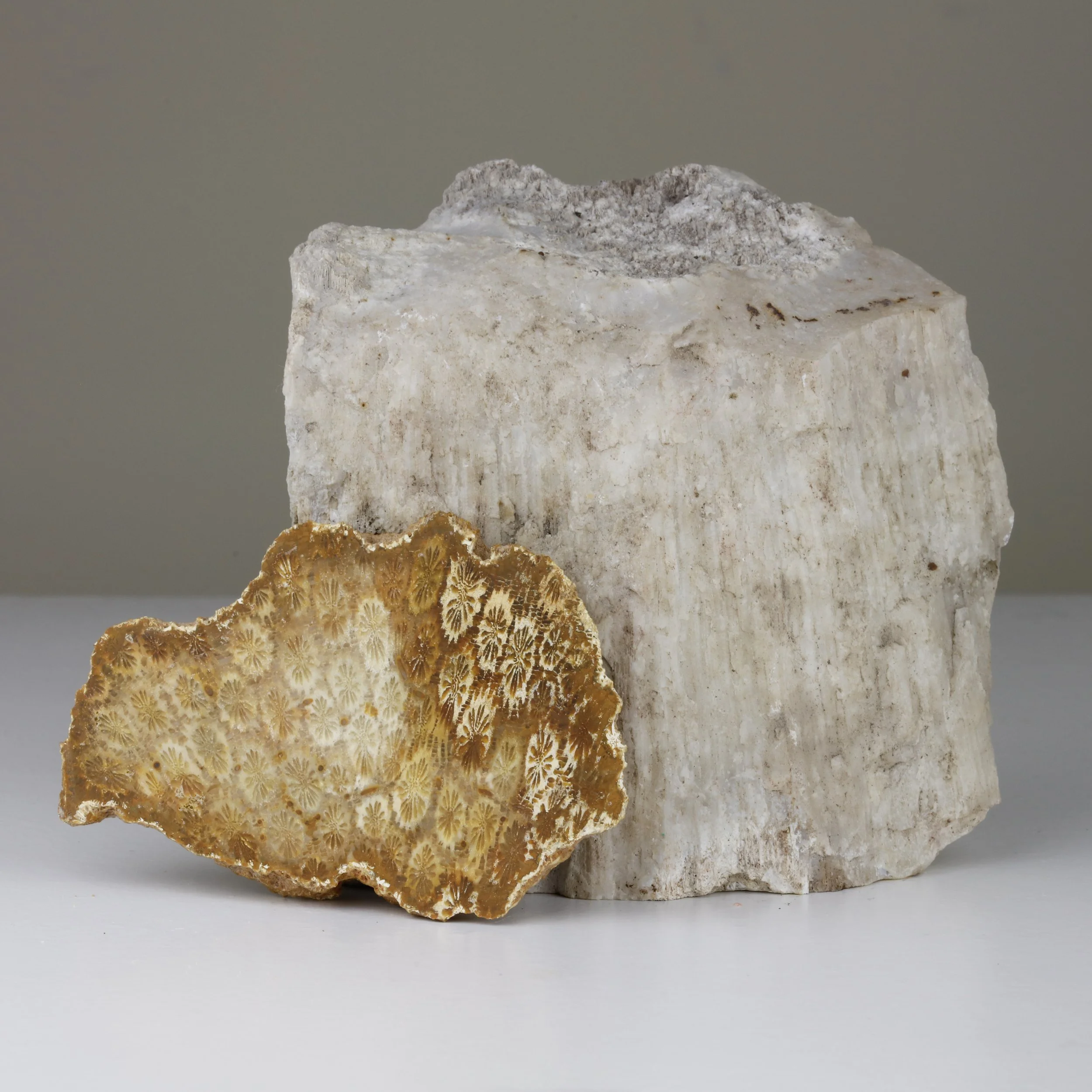
Example of agatized coral rough and a slab
What is agatized coral?
Agatized coral is a fossil rock that formed from the exoskeleton of corals that lived underwater 20-400 million years ago—depending on the coral and location. It is a chalcedony pseudomorph, meaning that silica-rich water trickled through ancient marine sediment and over time, replaced the calcium carbonate skeleton with microcrystalline quartz crystals.
Because the coral’s structure has been frozen in time during this long process, this is what gives agatized coral its unmistakable flower-like patterning in some pieces of solid coral. Here in Florida, agatized coral can also be a hollow, cave-like geode with botryoidal formations, pockets of druzy, or even stalactite-like chalcedony layers.
Agatized coral is often a yellow-orange color, but can also be white, gray, brown, red, pink or blue.

Inlay agatized coral cuff bracelet laying on the slab that I made it from
Using Agatized Coral in Jewelry
Solid agatized coral is commonly cut as a cabochon to use in jewelry, featuring a larger stone to accentuate the marine polyp patterning. Because of the unique structure of these fossils, the coral polyps should be oriented perpendicular when cutting or the patterning of the coral will appear stretched out.
This fossil coral makes a perfect statement stone because of its floral-esque look, and can be accented with other more colorful stones to harmonize with the coral’s typically neutral color. In my cobblestone inlay jewelry, I often pair agatized corals with solid blue, green, or purple stones to create a natural visual rhythm.
Another way I use this stone is by isolating a single bloom for a pair of stud or drop earrings, which has a different look than seeing all of the polyps together.
Indonesian and Florida agatized corals are my go-to for jewelry because they have the perfect balance of color, unique patterning, and strength.
Agatized Coral vs. Precious Coral
One of the main differences between agatized coral and precious coral is their age—agatized coral is from millions of years old corals and precious coral is from recently-living corals. Because agatized corals have been fossilized, they are a very hard, jasper-like stone with a Mohs of 6.5 or 7. Precious coral on the other hand is much softer, with the hardness of a copper penny at 3.5 on the Mohs scale.
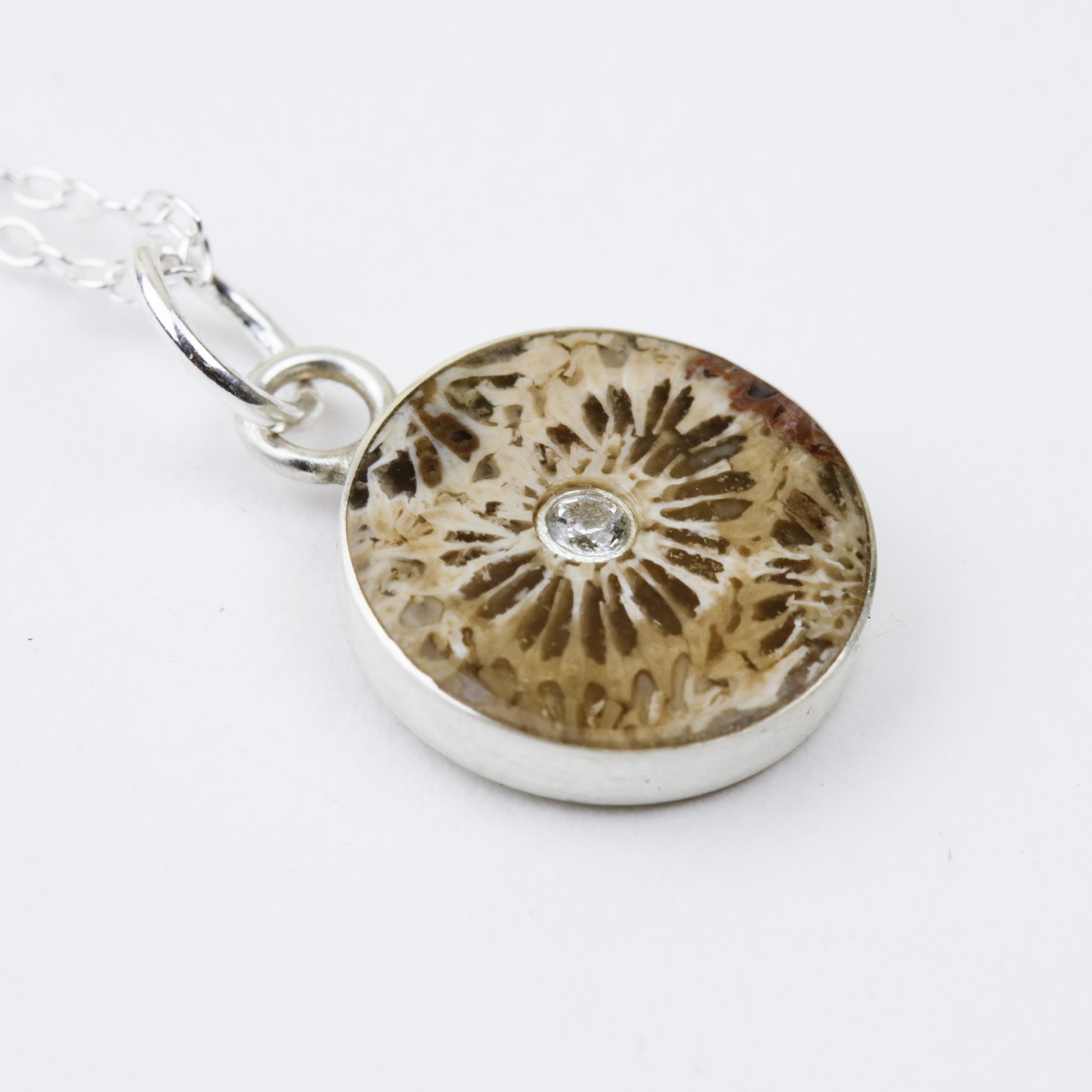
An example of where I isolated an agatized coral polyp in an inlay pendant, with a cubic zirconia added for accent.
Is agatized coral durable for jewelry?
Fully agatized coral is a very hard material, and oftentimes they are harder than some jaspers I cut for my jewelry. This kind of material is great for every pieces or for jewelry that gets a lot of wear, like a ring, as it’s going to be able to take some hits.
But like any material, there are some variances in the type of coral. For instance, porous agatized coral—marked by tiny pits in the surface—is not as hard as coral that is completely solid and fully agatized.
Petosky stones, a particular coral fossil found along the shore of Lake Michigan, are about the same hardness of precious coral (3-5 Mohs) so while they can be used in pendants or earrings, they are brittle and can scratch easily.
Agatized coral is an uncommonly-used stone in jewelry designs that is a great choice for those that love nature and fossils.