
The Artistry of Stone Intarsia in Jewelry

Custom intarsia cufflinks made with petrified sponge, jasper, and petrified wood, showing how seamlessly the stones merge in the shield design.
What is stone intarsia in jewelry?
In jewelry, an intarsia is a stone design where two or more pieces of natural stone with flat sides are held together with an adhesive to create a mosaic-like stone. Once it cures, the stone can be shaped and polished for use in jewelry designs.
Why are intarsias used in jewelry?
Unlike traditional jewelry settings where stones are separated by metal, intarsias allow stones to be seated flush next to each other, with intricate patterns that can’t be achieved any other way. The goal of an intarsia artist is to create perfectly flush connections so that there is zero gap between the stones to create a seamless appearance.
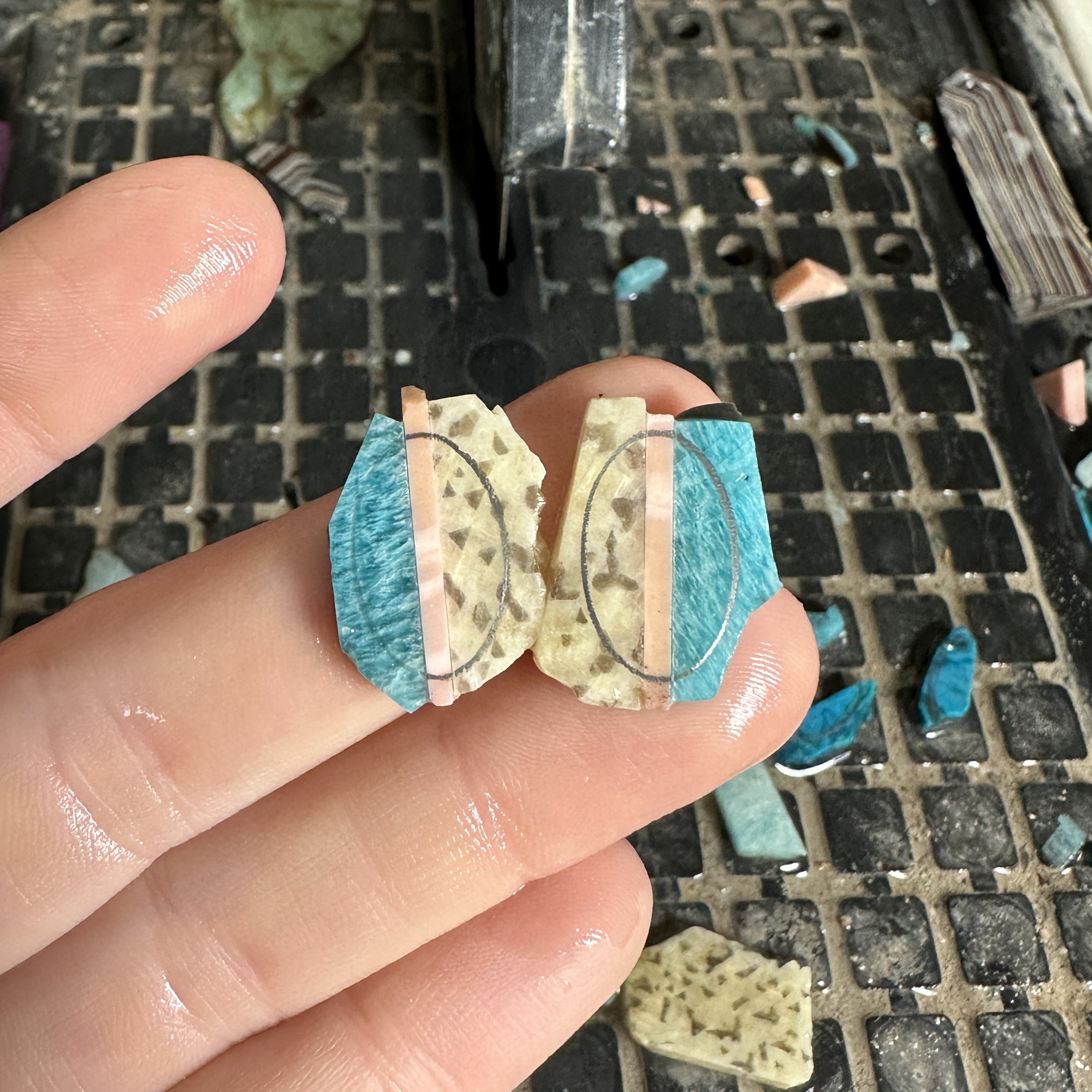
In-process of cutting a pair of intarsia stud earring, with an oval template drawn over the 3-stone mosaic.
How are stones set in intarsias?
Many intarsias use a cyanoacrylate glue (or CA glue) to hold the stones together, but I prefer to use a high-strength, water-clear epoxy in my intarsia jewelry. In my experience as a lapidary jeweler who also does inlay jewelry repairs, epoxy is more durable over time than CA glue, which can become brittle, crack much easier, then need to be repaired sooner.
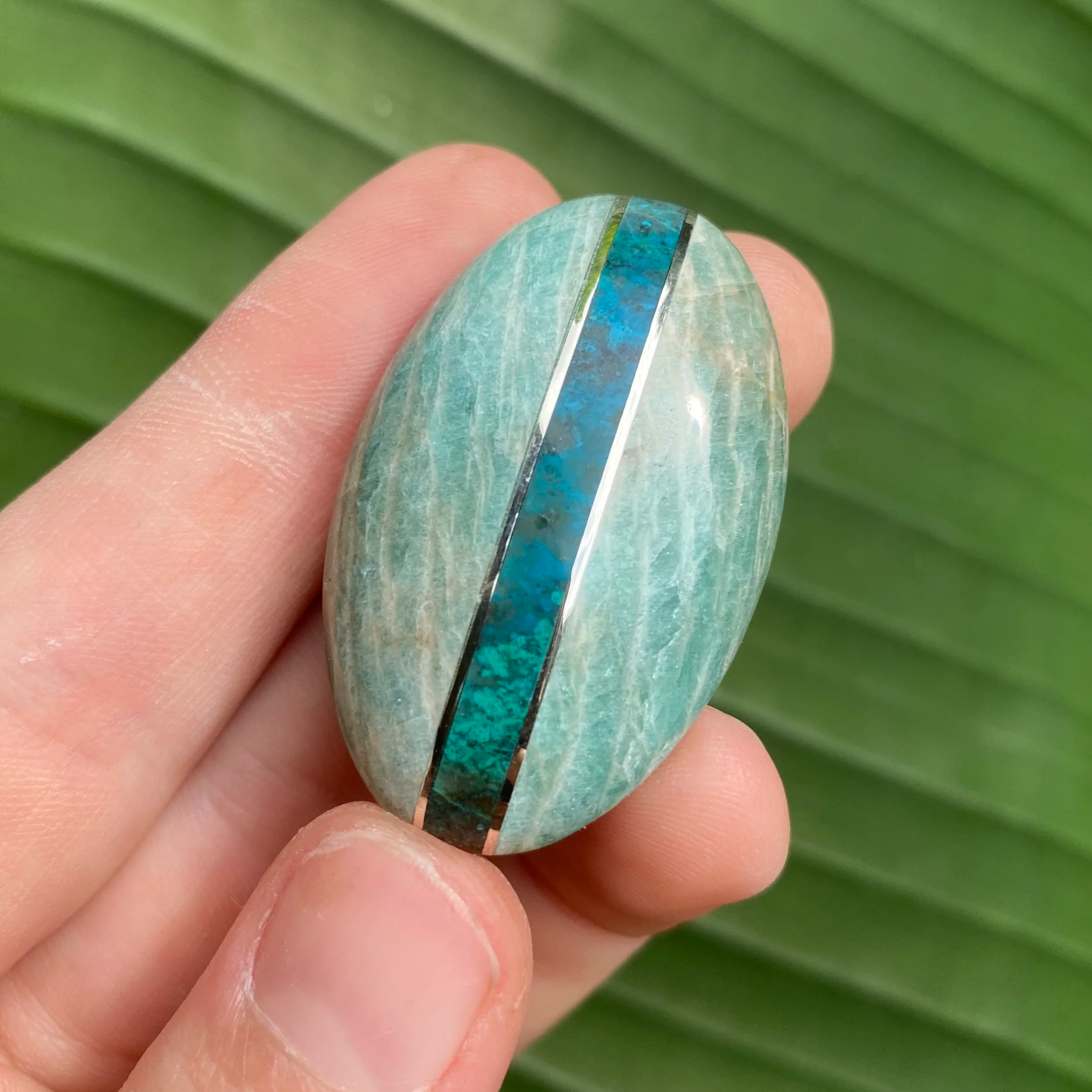
An unset custom stone intarsia with amazonite, chrysocolla, and sterling silver banding, showing how intarsias are stand-alone stone mosaics that can be set in different jewelry settings.
How is intarsia different from inlay in jewelry?
Intarsia has a lot in common with inlay jewelry, but is slightly different in its construction and its final form.
The biggest difference between the two is that inlay is where stones are set into a metal recess—so the term describes the merging of metal and stone into jewelry. Intarsia on the other hand, is a stand-alone stone mosaic that can then be set in a bezel or prong setting, wire-wrapped, or even inlaid.
Another difference is that intarsias are mostly done with flat faces connected to flat faces in geometric designs. Inlays are mostly done with geometric designs as well, but can also feature organic shaped stones.
Lastly, intarsias are most often made with a flat polished face. Inlays can be set flush to the metal jewelry design, or have domed surfaces as seen in cobblestone inlays.
Often the difference between intarsia and inlay is splitting hairs, but subtle differences in the construction can lead to slightly distinct results in a jewelry design.